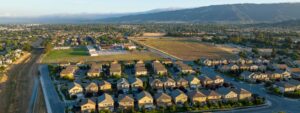
Standing by the bench, Coach Phil O’Loane hollers to one of his daughter’s teammates across the softball field. Just beyond the field rise the San Ramon hills, a natural boundary to the city with a view of cows grazing in pasture land. Phil, now a San Ramon city councilA city's legislative body. The popularly elected city council is responsible for enacting ordinances, imposing taxes, making appropriations, establish¬ing city policy, and hiring some city officials. The council adopts the general planA statement of policies, including text and diagrams setting forth objectives, principles, standards and plan proposals, for the long-term future physical development of the city or county. The general plan is a legal document required of each local jurisdiction by the State of California Government Code section 653o1 and adopted by the city council or board of supervi¬sors. In California, the general plan has seven mandatory elements (circulation, conservation, housing, land use, noise, open space, safety and seismic safety) and may include any number of optional elements (such as air quality, economic development, hazardous waste, and parks and recreation). The general plan may also be called a city plan, compre¬hensive plan, or master plan., zoningThe division of a city or county by legislative regulations into areas, or zones, which specify allowable uses for real property and size restrictions for buildings within these areas; a program that implements policies of the general plan., and subdivisionThe division of a tract of land into defined lots, either improved or unimproved, which can be separately sold or leased, and which can be altered or developed. ordinance. member, had no idea two years ago the role he would soon play in helping protect this landscape from urban development.
The area east of San Ramon, including the Tassajara Valley, is protected by urban growth boundaries that prevent the jurisdictions of San Ramon, Danville, and the county from expanding eastward.
In 2010 the San Ramon City CouncilA city's legislative body. The popularly elected city council is responsible for enacting ordinances, imposing taxes, making appropriations, establish¬ing city policy, and hiring some city officials. The council adopts the general planA statement of policies, including text and diagrams setting forth objectives, principles, standards and plan proposals, for the long-term future physical development of the city or county. The general plan is a legal document required of each local jurisdiction by the State of California Government Code section 653o1 and adopted by the city council or board of supervi¬sors. In California, the general plan has seven mandatory elements (circulation, conservation, housing, land use, noise, open space, safety and seismic safety) and may include any number of optional elements (such as air quality, economic development, hazardous waste, and parks and recreation). The general plan may also be called a city plan, compre¬hensive plan, or master plan., zoningThe division of a city or county by legislative regulations into areas, or zones, which specify allowable uses for real property and size restrictions for buildings within these areas; a program that implements policies of the general plan., and subdivisionThe division of a tract of land into defined lots, either improved or unimproved, which can be separately sold or leased, and which can be altered or developed. ordinance. attempted to expand its growth boundary, allowing sprawlThe process in which the spread of development across the landscape far outpaces population growth. The landscape sprawl creates has four characteristics: a population that is widely dispersed in low-density development; rigid separation of uses, so that homes, commerce and workplaces are segregated from one another; a network of roads laid out to separate land into huge blocks and offering poor access; and a lack of well-defined, thriving activity centers, such as downtowns and town centers. Most of the other features usually associated with sprawl – a lack of transportation choices, relative uniformity of housing options, and difficulty walking from place to place – result from these conditions. development across 1,579 acres. Phil co-led a successful effort by residents to stop the expansion, convincing 71% of voters to oppose the city’s measure.
Now Phil advocates to make open spaceAny parcelA lot, or contiguous group of lots, in single ownership or under single control, usually considered a unit for purposes of development. or area of land or water that is essentially unimproved and devoted to an open space use for the purposes of (1) the preservation of natural resources, (2) the managed production of resources, (3) outdoor recreation, or (4) public health and safety. protection a citywide priority. However, the threat of sprawlThe process in which the spread of development across the landscape far outpaces population growth. The landscape sprawl creates has four characteristics: a population that is widely dispersed in low-density development; rigid separation of uses, so that homes, commerce and workplaces are segregated from one another; a network of roads laid out to separate land into huge blocks and offering poor access; and a lack of well-defined, thriving activity centers, such as downtowns and town centers. Most of the other features usually associated with sprawl – a lack of transportation choices, relative uniformity of housing options, and difficulty walking from place to place – result from these conditions. in the Tassajara Valley still looms large. A powerful developer is pushing the county to approve a major development outside the growth boundaries. Approval of this sort of development would eviscerate the integrity of the growth boundary and put open spaceAny parcelA lot, or contiguous group of lots, in single ownership or under single control, usually considered a unit for purposes of development. or area of land or water that is essentially unimproved and devoted to an open space use for the purposes of (1) the preservation of natural resources, (2) the managed production of resources, (3) outdoor recreation, or (4) public health and safety. lands across the county at risk of similar attacks. Phil has stepped forward to protect his city from this proposal as well.
Phil’s effort in San Ramon is a model for other communities in Contra Costa County. For example, large swaths of the eastern county have been deemed fair game for development in Pittsburg, Antioch, Brentwood, and Oakley. Contra Costa County has the most acres at high risk of development of any county in the region—over 18,000. More action is necessary to preserve the hills, valleys, and rich farmland to help protect this land for future generations.