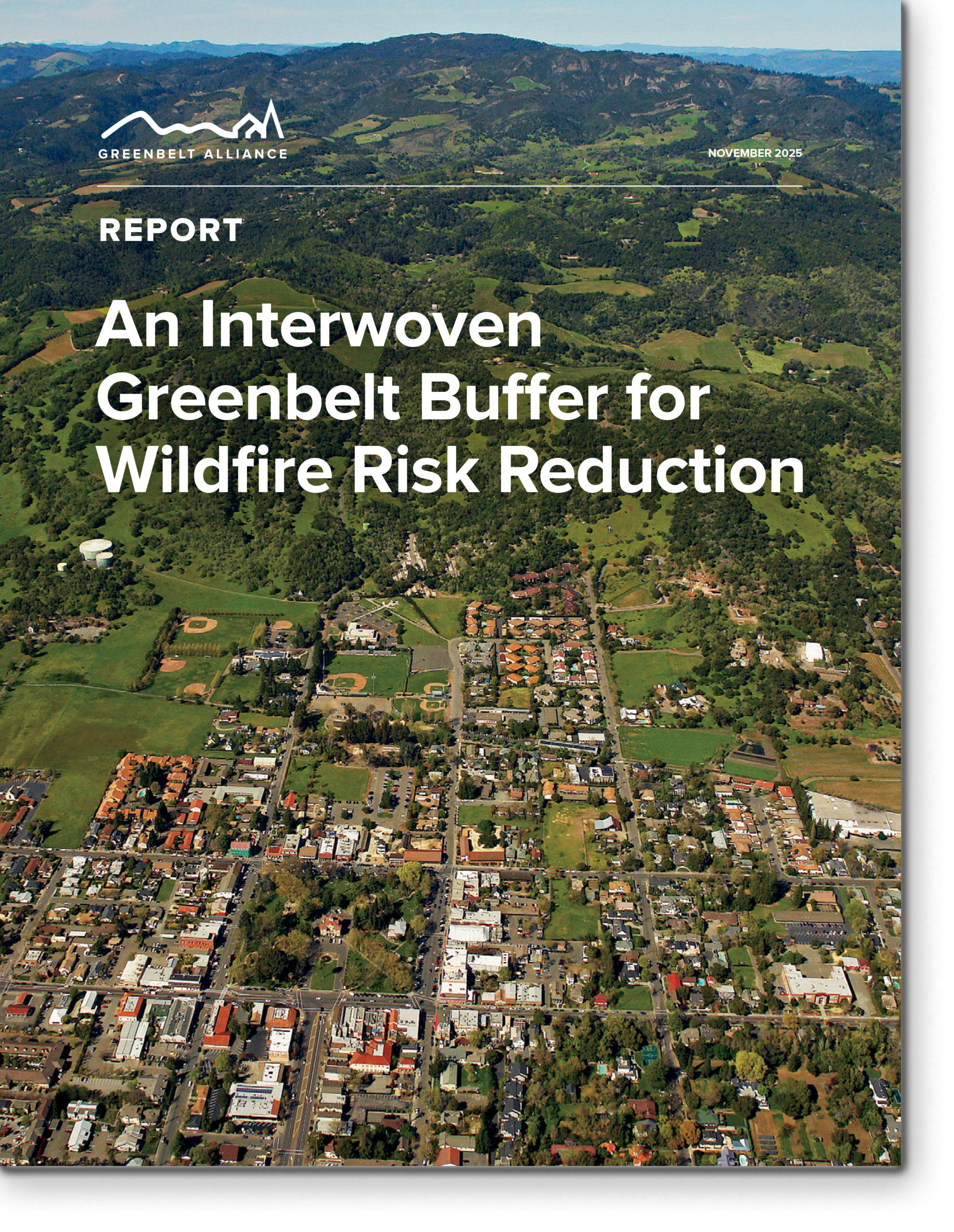
Over the last decade, Greenbelt Alliance has been advancing research on nature-based solutions and land-use planning best practices to achieve comprehensive wildfire resilience across our Bay Area landscapes. In our latest report, An Interwoven Greenbelt Buffer for Wildfire Risk Reduction, we discuss the challenges of implementing strategically-placed greenbelt buffers in existing communities, using Sonoma Springs as a case study.
One key takeaway from that research highlighted the need for regulatory and governance frameworks that enable effective collaboration among private property owners, government partners, and fire professionals.
One organization has emerged as a leader in doing just that – creating a collaborative system that delivers real results. Napa Communities Firewise Foundation (Napa Firewise) is a Napa County-based nonprofit supporting 25 Fire Safe Councils across the county.
This organization quietly built one of California’s most effective regional wildfire resilience models that centralizes grant writing, environmental compliance, and data collection under a single nonprofit “mothership” while keeping 25 community Fire Safe Councils as its connective tissue to residents on the ground- and in doing so, has already helped surface roughly $47 million in private resilience investments that firefighters and insurers never knew existed.
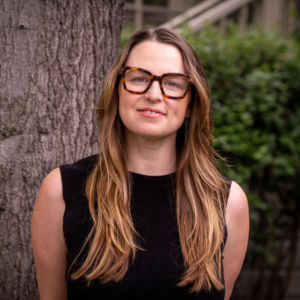
In this conversation, facilitated by Senior Director of Planning and Research, Sadie Wilson, Napa Firewise CEO Joe Nordlinger*, and Communications Director Stephanie Smithers** discuss how that structure works, the importance of engaging private landowners through their new Valley Stewards program, and how they’re bringing insurers back to fire-affected communities.

Joe Nordlinger* has been the CEO of Napa Firewise since 2024 and a volunteer with the organization since 2017. After the 2014 Wragg Canyon Fire got dangerously close to his hillside property in the lower Mayacamas, Joe was spurred to action. He got involved in the Mount Veeder Fire Safe Council, got trained as a volunteer firefighter, and has since continued to change the way we think about wildfire preparedness by bringing decades of experience in the business world to think differently about how communities work more efficiently and effectively to build resilience.

Stephanie Smithers** has been with the organization for two years after working in crisis communication and public information during the 2017 and 2020 fires in Napa Valley, and has been steeped in wildfire for the last decade, tracking wildland fire blogs, listening to radio traffic, and working to understand the landscape that her husband works in as a career firefighter.
This interview has been edited and condensed for clarity.
Curious to learn more? Read on for the in-depth conversation ⬇️ (click to expand)
Joe Nordlinger: In Napa, we filled a vacuum and were able to change the trajectory of how wildfire resilience was being approached in the county. We basically reorganized, recruited a new board, and decided that Napa Firewise would be the shared services platform doing all the grant writing, grants administration, environmental compliance, project development, and portfolio management for what are now 25 Fire Safe Councils.
There are absolutely lessons that could apply in other counties. One thing we’ve realized is that you have to think about your customers (homeowners, landowners, firefighters, etc.) and what the experience is like on their end. If the customer has to deal with nine different organizations, “Oh, you can go here for this. You can go there for that.” It just becomes so overwhelming and confusing that they tend to just get paralyzed.
That said, I’m aware we’re a smaller, more affluent county with fewer players and a tight alignment with CAL FIRE through Napa County Fire. But the core insight is structural efficiency. If you’re trying to support 20 different nonprofits, all with their own overhead, there simply isn’t enough money to do that. You have to be very efficient.
What we’ve uncovered is that there’s a lot of value in centralizing and aggregating data to drive better wildfire containment outcomes and better insurance outcomes.
If you have too many entities gathering their own data, you don’t benefit from the aggregation needed to get actionable intelligence to firefighters or tell a better story to insurers. And fragmentation is compounded by complacency; you go a few years without a fire, the vegetation grows back, and you can find yourself right back in a potential catastrophic situation.
Stephanie Smithers: The community preparedness paired with the fuels management that we do is imperative to supporting wildfire response. It really helps us burn on our terms so we can help manage fire behavior and create opportunities for firefighters to contain wildfires faster and more safely.
What Napa Firewise does well is understand that we must be flexible. It isn’t a cookie-cutter approach. The needs and risks vary by neighborhood, terrain, and landowner profile. Our communities run the full spectrum, from very affluent neighborhoods to rural areas with very limited means. We walk each Fire Safe Council through their own community wildfire protection plan rather than expecting them all to fit into one bucket.
JN: Our model is efficient because all our Fire Safe Councils are essentially satellite entities that are part of us. They’re our connective tissue into the community. They help us push communications out, feed us project priorities, and we do the care and feeding in return: collateral, project delivery, grant writing, support with their community marketing.
For many Fire Safe Councils, it might be a retired teacher or a landowner running things. To expect them to write grants, do environmental compliance, and manage vendors is totally unrealistic.
Our model works because they can rely on us for all that back-end heavy lifting, while they stay focused on the community, which keeps us from getting complacent, because that’s the other big challenge in wildfire.
Every Fire Safe Council has its own Community Wildfire Protection Plan and NFPA Firewise designation, but they all roll up into the countywide CWPP. And all project priorities on the fuel and containment side are determined by the firefighting authorities (Napa County Fire, the city fire departments, CAL FIRE), not by us unilaterally.
JN: The program grew out of the reality that Napa, and this isn’t unique to Napa, has a lot of large landowners holding forested land, oak woodland, and mixed hardwood conifer forests, both burned and unburned from the major fires of the last seven years. To think about county-wide resilience, we have to figure out how to work with those landowners and understand what their needs are.
We ran focus groups and quickly discovered a few distinct groups. There are landowners with financial means who have done tremendous fuel mitigation, road improvement, and water storage work that nobody knows about. There are landowners willing to do more but who need to know it’ll improve their insurance or that firefighters will actually use the elements the landowner invests in. And then there are what we call property-wealthy but means-challenged landowners sitting on 450 acres with generational wealth tied to land at a very low tax basis, living on a fixed income, with limited capacity to invest.
The insight is that many of these large landowners possess critical locations for wildfire containment—about 25,000 to 30,000 of the 40,000 to 60,000 acres of forested land around the county—are strategic and critical. Firefighters look at topographically significant locations: where’s a ridge, a spur ridge, a wide saddle or bench? Those are places where they can take a stand and stop a fire. Many of those landowners already have legacy fire roads, ponds, reservoirs, areas of grazing and understory clearing, and if we can map those things and get them to firefighters as actionable intelligence, it improves containment outcomes. That’s the underpinning of Valley Stewards.
JN: Let me preface this by saying the insurance issue is very complicated, and I’m not going to claim this solves California’s insurance crisis. But we do seem to be making a difference because we’re helping insurance companies get a better understanding of contextualized risk around certain properties. Once they understand that some properties are more strategic by virtue of the resilience attributes landowners have invested in, they recognize those as likely priority locations where firefighters will want to take a stand.
We’re not telling insurers, “these properties can withstand a wildfire” or that “firefighters are going to save that house.” We’re saying: this 500-acre property has three and a half miles of critical dozer lines on a ridge, abundant water, good staging…those are properties firefighters want to know about because they could mount backfiring operations or retardant drops there. That changes how an insurer thinks about that property, and about the properties adjacent to it. We initially thought it would take ten years to develop 100 of these enhanced resilience sites (a formal designation we worked out with CAL FIRE). In our first year, we already have around 200 landowners enrolled and expect to reach 350 or so sites in three years.
If we can build large enhanced resilient sites around a suburban neighborhood, then the insurance companies are saying that they would think differently about those neighborhoods [because] we can provide actionable intelligence to firefighters about where they can take a stand before the fire even gets into the neighborhood and we can build these big swaths of resilience and buffering layers, that helps to protect those [suburban] neighborhoods as well.
We’ve participated in about a dozen insurance renewals that resulted in substantially lower premiums, increased coverage, better terms, and, in about four cases, got people off the FAIR Plan entirely. Another 15 or so renewals are in process now. CAL FIRE is also interested in expanding this framework to potentially six or eight additional counties.
SS: To simplify – for non-insurance people, myself included – what Joe is describing isn’t about individual policies, but about creating a recognized standard of mitigation that the market can respond to, giving insurers something they’ve never had before: real, verifiable data about what’s actually been done on the land. CAL FIRE told us what they need for rapid containment and response. We built this around that.
SS: One thing we pride ourselves on is that we generally don’t use fear-based marketing. You see a lot of organizations sharing structure-loss imagery over and over again. For our community, they know what that feels like. I don’t need to share triggering content—our hillsides have the scars. That’s enough.
The power of our organization is that we have all these Fire Safe Councils. We are locals. This is a neighborly effort, and we have those trusted local connections with institutional support behind it. We’re not a government organization, but we have the backing of our fire authority, the county, and electeds—while also having grassroots community trust. We speak concisely, clearly, and lean toward the technical side, which shows we know what we’re doing. We also use an agnostic approach to fuels treatment. It could be grazing, it could be mechanical treatment. Why does it matter? What matters is risk reduction.
And the messaging must change community by community. We’re constantly asking: how do we speak to the people of Napa City differently than the people of Calistoga? How do you speak to people in the suburbs versus those in the wildland-urban interface?
JN: The communities with the largest wisdom about this are often the ones that have directly experienced wildfire. They know what it feels like to be evacuated, to see fire on their hillside. In more suburban areas where wildfire has been a distant threat, it’s challenging to ask people to foot the bill. Enough time goes by without a fire, and people forget. Fire doesn’t care about a city boundary or a county line; it moves on fuel, weather, and topography, but keeping that reality in people’s minds is its own ongoing job.
JN: We consider ourselves realistic optimists. Fire will come again, but we think we can be prepared for it. When we started enrolling large landowners into the Valley Stewards Initiative, we uncovered something like $47 million in resilience investments—expanded water, improved roads, fuel reduction—that had been made privately but never captured or considered by firefighters or insurance companies. Meanwhile, we’ve been out there raising $36 million in grant funds and over $26 million in County Funds. Private industry, among just the first 100 landowners, has already matched nearly that amount, and we’re uncovering more and more of it.
By almost every measure we are far better off than we were in 2017 and 2020. PG&E has hardened a lot of infrastructure. More people have solar panels, batteries, or generators. Thousands of acres of fuel mitigation and forest health work have been completed. There’s a lot still to do, but we’re far more resilient now.
I’d also add that maintaining fire roads is one of the most cost-effective ways to mitigate risk, even if it sounds counterintuitive ecologically. We’re far better off maintaining existing roads properly, with water bars and erosion control, than letting them fall into disrepair and having firefighters push roads in an emergency in ways that aren’t ecologically sensitive. Good roaded infrastructure is valuable for containment and for doing prescribed fire, grazing, and forest health work.
SS: We know that pre-fire work makes a difference. We saw this in 2025. There was a fire in Napa County last year that, without pre-fire work, had every opportunity to greatly disrupt the communities of Angwin and Pope Valley. They contained it pretty quickly with zero structure loss. CAL FIRE said at their press conferences that they used those mapped resources in their operational planning. That’s enough for me to continue this work for the next hundred years.
And for anyone concerned about costs, these efforts reduce firefighting costs, too. If firefighters can contain fires faster, that’s fewer resources on the ground. The cost of rebuilding a single home in Napa County is greater than the critical ridgeline fuel break we just finished in the Mount Veeder area. The return on investment for doing this work ahead of time is massive. We’re honored to take the responsibility seriously, creating environments for firefighters to respond effectively and safely.
JN: For individual landowners: maintain vigilance, stay on top of notifications, track weather and fire conditions, and make those investments in defensible space and home hardening where you can. At the agency level, collaboration is everything. We can learn from [other counties], and we’re happy to share what we’re doing here.
SS: People should join their local Fire Safe Council. Even if you’re a quarter-acre property owner in the middle of town, there is something really empowering about working with your neighbors. Whether it’s a community work day, sharing education, or just inspiring one another, that connection matters. And it’s one of the most powerful ways we know to keep communities engaged over the long term.
Learn more about our research and download the Interwoven Greenbelt Buffer Report Today.
Banner photo: Visit at Seavey Vineyard, in Napa, where they actively manage vegetation to reduce wildfire risks and improve resilience. Photo by Daniela Ades/Greenbelt Alliance.