

The author, Betsy Pfeiffer, was a UC Berkeley Goldman School of Public Policy (GSPP) Fellow and Greenbelt Alliance research collaborator between February and May 2026.
How do we help Californians understand that building homes in existing communities is good for commutes, wallets, and the environment? Over the first half of 2026, I had the opportunity to work with Greenbelt Alliance to identify existing housing and climate narrative strategies and develop guidance to increase impact.
To understand how Greenbelt Alliance can communicate this link more effectively to Californians, I consolidated existing research, recent polling done by EMC Research, and stakeholder input into a best practices playbook for communicating about climate and housing in California.
According to polling from 2025, California voters’ top five issues are cost of living, housing, crime, traffic, and climate change. Local land-use policies that prioritize infill development can address four out of five of those issues, but that same poll also showed that most voters don’t understand that connection. When asked what local governments could do about climate change, only 3% of respondents said housing policy, and a third of all respondents had no answer at all.
California has historically prioritized housing development on undeveloped land outside of existing communities—known as sprawl. These policy choices have normalized long commutes while driving up the cost of living, increasing traffic, and undermining Californians’ health and quality of life. These land use patterns also lead to more Californians living in areas that are vulnerable to wildfire and floods, which fuels insurance pressures that drive up housing costs statewide. In turn, pollution and global warming gases from so many long commutes are contributing to climate change.
While the links between housing and climate change are clear to many of us working in the field, they can be difficult to talk about in a way that resonates with the general public. There is a growing body of research on the most effective ways to communicate about the environment and housing separately, but little guidance exists on how to connect them.
Day-to-Day Life Resonates
The single most consistent finding from the research, the polling, and the advocates I interviewed is that messages rooted in tangible, everyday benefits outperform everything else. Quality-of-life messages combine those top four concerns from the poll—cost of living, housing, affordability, and climate change—by emphasizing that more housing in existing neighborhoods means less time in traffic, less money spent on gas, and less impact on the environment.
Shorter commutes, walkable neighborhoods, and living closer to family are messaging winners.
The Environment Belongs in The Story

Environmental messages poll well in California, and research suggests that pairing them with quality-of-life framings strengthens the narrative, but the right environmental angle varies by audience.
Urban Californians, for example, seem to respond most to framings that treat care for the environment or fighting climate change as broad values, not aligned with specific actions.
When speaking to rural and suburban residents, conservation messages, in contrast, may be more effective. And framing matters—”Protecting open space” earned strong support, but “stopping sprawl” did not. This difference reflects a broader best practice principle to link messages to existing concerns and keep the framing proactive and solutions-oriented.
Developing a positive framing for stories about disaster avoidance is a bigger challenge. Fire and flood hazards are among the most effective ways to connect housing and climate change, but to work as a housing development narrative, these messages need to execute a pivot that can be difficult to pull off. Moving from why “not to build” in certain places to “why to build” in others can be difficult to communicate effectively and simply in a single message. For now, wildfire threats and insurance pressures seem to land most powerfully with rural and suburban Californians, but urban residents are beginning to share those concerns as climate impacts reach more of the state.
The research demonstrates that quality of life framing applies broadly, but a more nuanced approach is needed when talking to urban versus suburban/rural audiences. Additionally, staying safe from fire and flood is a promising narrative for all Californians, but the messaging needs to be refined and tested. Finally, simpler is better: trying to combine all of these into a single message risks diluting the impact of each.
The Big Picture
Greenbelt Alliance and allies have the opportunity to shift the current public perspective on both housing and the environment to emphasize that housing is a climate solution. The quality of life plus environment pairing has strong evidential support, but it has yet to be tested. And while stakeholder input suggests that separating audiences into urban versus suburban/rural is a reasonable starting point, it’s an inference rather than a tested finding.
Encouragingly, Californians already care about what infill housing can deliver: shorter commutes, lower costs, walkable neighborhoods, land protection, and a healthier climate.
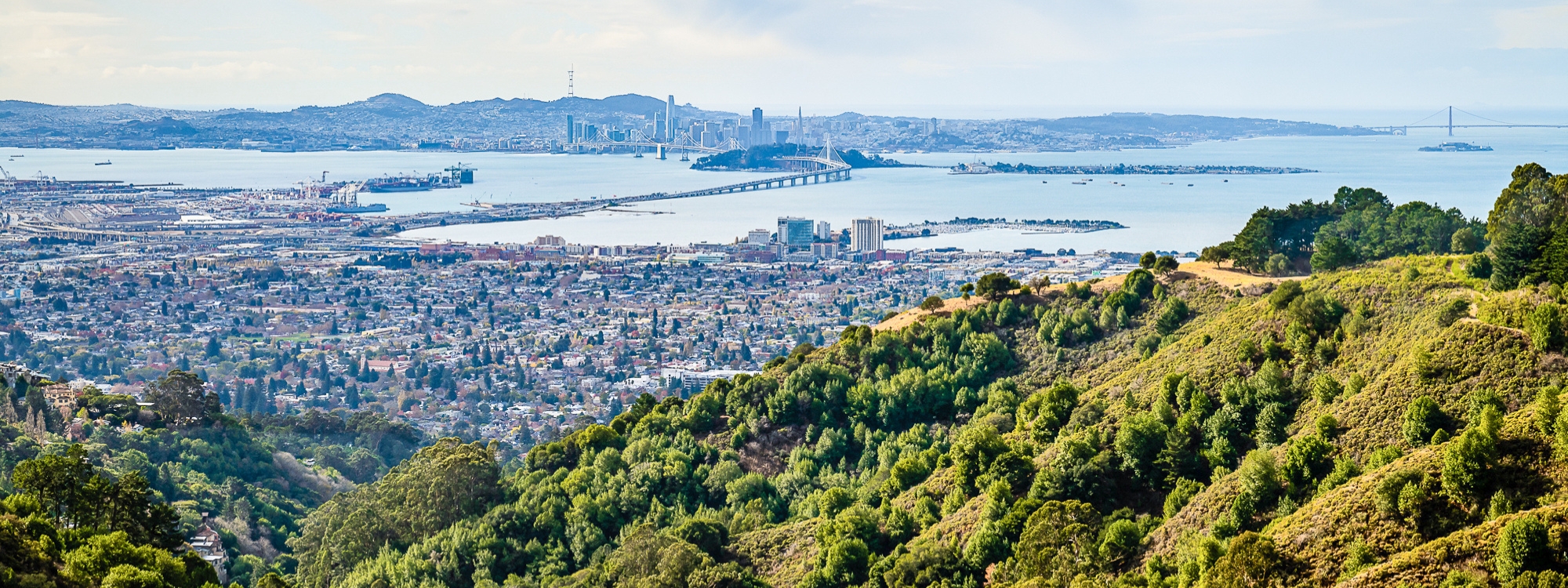
Header Photo: View from Berkeley Hills. By Chris LaBasco Photography