
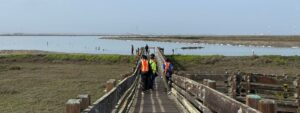

Keep Fighting to Protect Newark Baylands From Development; Sign Petition
Help us reach 3,000 signatures to protect Newark’s baylands from development.

We’re developing planning guidance, innovative policy strategies, and key partnerships that will bolster capacity and support local and regional efforts to implement equitable, climate-resilient land-use decisions.
Educate local, regional, and state government leaders on the climate-resilient land-use policies to prioritize, including nature-based solutions to wildfire, flooding, and drought, and prioritizing low-income communities of color who face the most serious impacts of climate change with the fewest means to adapt. For example, we released The Critical Roles of Greenbelts in Wildfire Resilience, a groundbreaking white paper that presents original research and an assessment of case studies that identifies four types of greenbelts that play a role in reducing the loss of lives and homes in extreme wildfire events while increasing overall resilience in communities and across landscapes. We also launched the Resilience Playbook, a guide for accelerating equitable adaptation to the climate crisis in the Bay Area. It offers a holistic approach to advancing solutions that address overlapping environmental, economic, and social challenges. The Playbook brings together curated strategies, recommendations, and tools to support local decision-makers and community leaders wherever they are in their journey.
Advocate for incorporating adaptation measures and innovative policy solutions into ongoing and future planning efforts, and the meaningful involvement of all people in these environmental and land-use decisions. Greenbelt Alliance is in a unique position to activate community members who already have an interest in sustainability, climate change, and environmental justice, around climate-smart housing initiatives. By working together with climate justice leaders, housing advocates and environmentalists side by side, this powerful group of stakeholders can play a transformative role in building the thriving, equitable region we need. We are doing this through our Advocacy Workshop Program, which includes an interactive session where attendees gain a base-line understanding of the local planning processes that address housing and climate needs. We also mobilize community members to take action on local policies—leveraging their voices and voting power to target key decision makers in order to a) approve climate-resilient plans and policies and b) hold elected officials accountable for implementing adopted policies.
Collaborate with various agencies, sectors, jurisdictions, and diverse community-based organizations to unlock regional coordination in planning for climate impacts. We are leading a coalition of grass roots and nonprofit environmental organizations along with leaders in Contra Costa, providing detailed suggestions that reflect our vision for a climate resilient future that should be implemented in the County’s General Plan and Climate Action Plan updates.
We have released original research documenting the role of greenbelts as policy tools for wildfire resilience.
We are creating easy-to-use guidelines documenting climate-resilient land-use policies and template language to build capacity for cities and counties in their local planning.
We are conducting policy analysis on best practices and cutting-edge, market-based approaches to unlock bold policy solutions to wildfire mitigation and resilience.
We are connecting with stakeholders across the region to discuss coordinated plans to address Bay Area wildfire planning and resilience.

Help us reach 3,000 signatures to protect Newark’s baylands from development.

In February 2021, after hearing from hundreds of Pittsburg residents and environmental organizations that the city should preserve the beautiful hills that overlook the future park at the former Concord Naval Weapons Station, Pittsburg’s City Council approved the Seeno Faria project. The homes would be zoned for single-family residential with a 4,000-square-foot minimum lot size.


San Francisco is currently undergoing a state-mandated rezoning of the city. According to the Housing Element, the city must adopt a rezoning map that will result in the construction of roughly 36,000 new homes by 2031. This rezoning, combined with the construction of already approved projects and projects already allowed under current zoning, gets the