Introduction
Greenbelt Alliance launches the Interwoven Greenbelt Buffer for Wildfire Risk Reduction Report, documenting the methodology, key findings, and recommendations from the Sonoma Springs Pilot Project and introducing a new strategy to manage wildfire risk: the Interwoven Greenbelt Buffer. This innovative land-use approach is informed by years of research highlighting the critical role greenbelts play in reducing wildfire risk.
Read the full report for an in-depth look into the research and its key recommendations. Download the report today
Download Executive Summary
Download Full Report
The report documents the 20-month trajectory of the Sonoma Springs Pilot Project, led by Greenbelt Alliance, in partnership with the Sonoma County Agricultural Preservation and Open Space District (Ag + Open Space) as the lead government partner, with participation from various other critical stakeholders, including science and fire experts (Sonoma Ecology Center and Pepperwood Preserve), local advocacy organizations representing the community’s large Latino population (Latino Service Providers), and local landowners and vintners. This effort was funded by the Bay Area Council’s California Resilience Challenge.
As we see continuous increases in devastating wildfires impacting these communities, we must not only stop expanding development in these areas but also figure out how to retrofit existing communities on the urban edge to better withstand wildfire risk.
A New Approach: The Interwoven Greenbelt Buffer
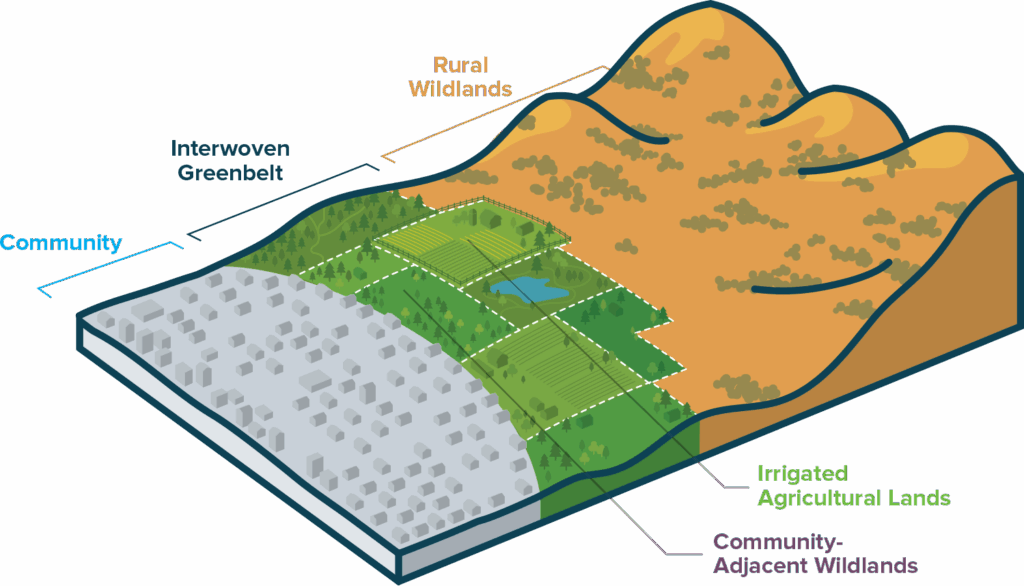
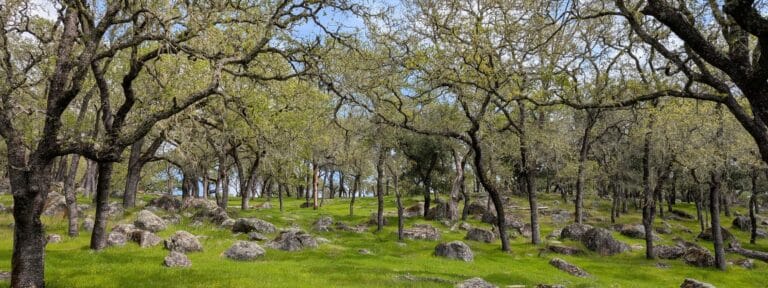
Building on years of research— including our 2021 white paper The Critical Role of Greenbelts in Wildfire Resilience— and existing land-use tools, the report introduces a new concept: the Interwoven Greenbelt Buffer. This innovative approach weaves together non-contiguous lands that already act as buffers—such as irrigated farmland and vineyards—with privately owned grasslands and woodlands to complete an “interwoven greenbelt” that strategically protects communities from wildfires.
While it may seem like a simple solution, the approach of an Interwoven Greenbelt that emulates the benefits of a traditional greenbelt has never been articulated in this way before.
This emerging concept is more cost-effective and applicable to other wildfire-prone communities in the Western US, and creates a path forward for increasing wildfire risk reduction.
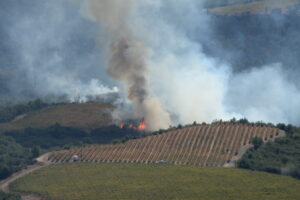
Banner photo: California Army National Guard Black Hawk conducted water drops on the Northern California Fires in and around Santa Rosa on Oct. 12, 2017. Credit: California Air National Guard photos by Master Sgt. David Loeffler.
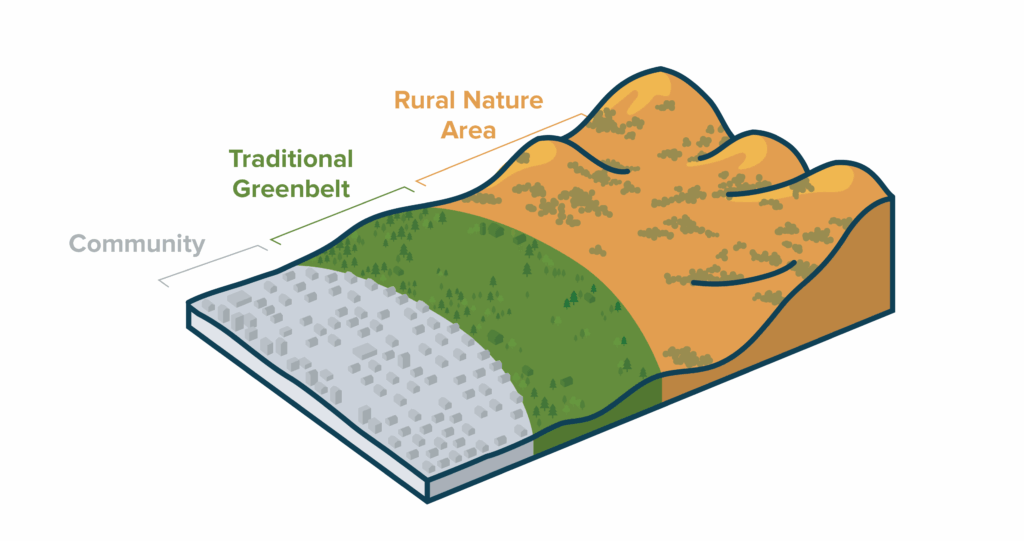
From a traditional to an Interwoven Greenbelt Buffer: acquisition and easements have long served as go-to approaches to creating a traditional greenbelt buffers. However, creating a contiguous greenbelt of primarily public land often proves infeasible due to cost and coordination challenges. The Interwoven Greenbelt Buffer approach weaves together non-contiguous lands that already act as buffers with privately owned grasslands and woodlands to create similar benefits of a traditional greenbelt.
WHAT'S IN THE REPORT
By outlining our methodology, key findings, and next steps, this report serves as a blueprint for other fire-prone communities to create a similar Interwoven Greenbelt Buffer, tailored to local geographical contexts. This new land use tool is designed to enable California and other states to simultaneously reduce wildfire risk and maximize protections for people and nature.
METHODOLOGY
The Sonoma Springs Pilot Project team conducted a comprehensive spatial analysis of multiple datasets and identified locations where high wildfire risk overlaps with wildfire-vulnerable communities and conservation priorities—then, consulted with Sonoma County’s vegetation management Technical Advisory Committee to review the data and to provide input informed by local ongoing projects, agency priorities, and partner programs.
KEY FINDINGS
- To move forward with this solution, three resources must be brought together:
- 1. funding tools,
- 2. political mechanisms, and
- 3. a management and enforcement entity.
NEXT STEPS
From these three concepts, we identify six next steps that are key to the implementation of the Interwoven Greenbelt Buffer in Sonoma Springs.
These steps build on the strengths and challenges present in Sonoma Springs and will allow the buffer project to reduce community-scale wildfire risk of the region effectively. To learn more about these steps and the reasoning behind them, access our full report.
EXPLORE OUR WORK PILLAR "LIVING WITH WILDFIRE"


An Interwoven Greenbelt Buffer for Wildfire Risk Reduction